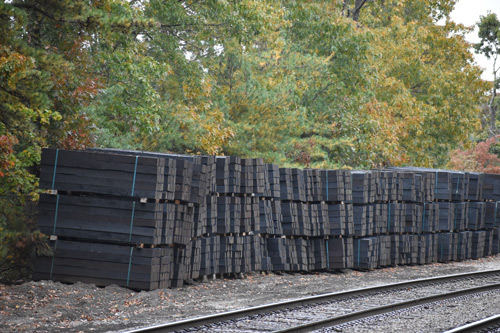
Stacks of bundled railroad ties beside train tracks in Massachusetts, with trees in the background.
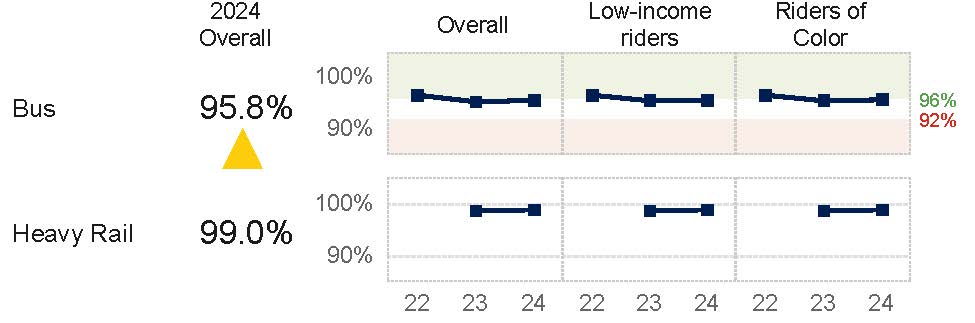
A diagram with line charts showing Passenger Comfort performance for Bus and Heavy Rail services. For 2024, Bus had an overall score of 95.8%, below its target of 96% but above the performance minimum of 92%; Heavy rail had an overall score of 99.0% and did not have a performance target or minimum. Bus had overall scores of 96.8% in 2022, 95.5% in 2023, and 95.8% in 2024; scores for Low-Income Riders of 96.8% in 2022, 95.7% in 2023, and 95.8% in 2024; and scores for Riders of Color of 96.8% in 2022, 95.7% in 2023, and 95.9% in 2024. Heavy Rail data is not available for 2022. Heavy rail had overall scores of 98.8% in 2023, and 99.0% in 2024; scores for Low-Income Riders of 98.8% in 2023, and 99.0% in 2024; and scores for Riders of Color of 98.8% in 2023, and 99.0% in 2024.
Passenger Comfort was strong overall but fell short of the target for heavy rail service.
Commute times vary across counties. The longest average commute is experienced by residents of Norfolk County, at 34.6 minutes, and the shortest is experienced by residents of Nantucket County, at 13.5 minutes.

Outside of the island counties of Nantucket and Dukes, the shortest commute is experienced by residents of Berkshire County, at 20.4 minutes.
Relative to most other Tracker metrics, the Rail safety metrics assess the performance of both public and private operators across the state. In other words, the rail network is unique in that a large share of its assets and services are owned and operated by private businesses.

So, while these indicators are key to understanding the safety of the rail network, they do not necessarily reflect MassDOT assets or operations.
Safety continues to be a priority of MassDOT. While some safety areas have improved, others have not, and MassDOT continues to focus on improving transportation safety across the Commonwealth.
Stacks of bundled railroad ties beside train tracks in Massachusetts, with trees in the background.
A diagram with line charts showing Passenger Comfort performance for Bus and Heavy Rail services. For 2024, Bus had an overall score of 95.8%, below its target of 96% but above the performance minimum of 92%; Heavy rail had an overall score of 99.0% and did not have a performance target or minimum. Bus had overall scores of 96.8% in 2022, 95.5% in 2023, and 95.8% in 2024; scores for Low-Income Riders of 96.8% in 2022, 95.7% in 2023, and 95.8% in 2024; and scores for Riders of Color of 96.8% in 2022, 95.7% in 2023, and 95.9% in 2024. Heavy Rail data is not available for 2022. Heavy rail had overall scores of 98.8% in 2023, and 99.0% in 2024; scores for Low-Income Riders of 98.8% in 2023, and 99.0% in 2024; and scores for Riders of Color of 98.8% in 2023, and 99.0% in 2024.
This section is 100 words. It is separated as two chunks. This is the first chunk of two. Commute times vary across counties. The longest average commute is experienced by residents of Norfolk County, at 34.6 minutes, and the shortest is experienced by residents of Nantucket County, at 13.5 minutes.

This section is 100 words. It is separated as two chunks. This is the second chunk of two. Commute times vary across counties. The longest average commute is experienced by residents of Norfolk County, at 34.6 minutes, and the shortest is experienced by residents of Nantucket County, at 13.5 minutes.
One such initiative was the MBTA Track Improvement Program (TIP) that implemented major track repairs across all rapid transit lines to address speed restrictions. These emergency safety measures keep riders and crew safe amid the tough conditions our rail system sees throughout the seasons and allows essential work to be performed. After replacing over 250,000 feet of rail and nearly 13,000 ties, the MBTA eliminated over 220 speed restrictions to become completely speed restriction free by December 2024. With a renewed focus on customer experience, safety, and service reliability, the T now utilizes speed restrictions as needed to manage the impacts of extreme weather and regular maintenance to ensure continued quality service, with the median restriction removed after just
5 days.
A safe transportation system requires constant effort, maintenance, and accountability. Despite excellent progress in some areas, we also saw troubling increases in roadway work zone fatalities and in MBTA safety incidents.  

Keep scrolling to see how MassDOT is already taking steps to address these safety concerns.
This section is 120 words. It is a single chunk. Commute times vary across counties. The longest average commute is experienced by residents of Norfolk County, at 34.6 minutes, and the shortest is experienced by residents of Nantucket County, at 13.5 minutes. Commute times vary across counties. The longest average commute is experienced by residents of Norfolk County, at 34.6 minutes, and the shortest is experienced by residents of Nantucket County, at 13.5 minutes. Outside of the island counties of Nantucket and Dukes (which includes Martha’s Vineyard), the shortest commute is experienced by residents of Berkshire County, at 20.4 minutes. The other counties (or former counties) in Massachusetts are Franklin, Hampden, Hampshire, Worcester, Middlesex, Essex, Bristol, Barnstable, and Suffolk counties.
Through these programs, accountability through Tracker, and constant teamwork, MassDOT will continue to improve safety conditions for both our transportation users and employees across the Commonwealth.